
Stakeholders engage to translate Belize’s sustainable ocean priorities into coordinated action
Representatives of key government ministries, departments, and regulatory agencies are among the stakeholders attending the two-day BSOP workshop
Belize City, Belize, Tuesday, 20 October 2026 (CRFM)—Stakeholders from across Belize's governance, regulatory and ocean management landscape are meeting in Belize City for the Belize Sustainable Ocean Plan (BSOP) Implementation and Monitoring Plan Validation and Co-Design Workshop, an important step towards translating the country's sustainable ocean priorities into practical, coordinated and implementable actions.
The workshop is being led by the Coastal Zone Management Authority and Institute (CZMAI) with support from the BE CLME+ Project and over the next 2 days, brings together representatives of key government ministries, departments, regulatory agencies and other stakeholders that have responsibilities for, or will be affected by, implementation of the BSOP.
The workshop moves beyond consultation to focus on validation, feasibility testing and co-design. Participants are critically reviewing the proposed implementation and monitoring arrangements to determine what will be required to translate the BSOP's strategic priorities into coordinated action.
Through facilitated discussions and working sessions, stakeholders are examining the feasibility of proposed actions and generating clear recommendations and decisions on:
- priority actions for implementation;
- the roles and responsibilities of relevant government and regulatory agencies;
- institutional and inter-agency coordination arrangements;
- environmental, social and other relevant safeguards;
- human, technical and financial resource requirements;
- practical considerations that could enable or constrain implementation; and
- arrangements for monitoring progress and supporting accountability.
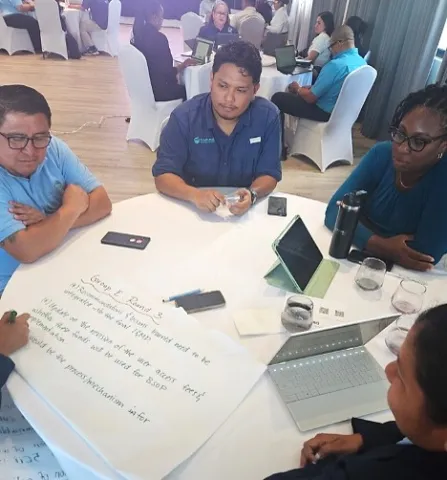
Attendees brainstorm to strengthen implementation and monitoring. Photo: BE-CLME+ Project
A key focus of the workshop is ensuring that the proposed Implementation and Monitoring Plan reflects the realities of the agencies and stakeholders that will ultimately be responsible for delivering the BSOP. This participatory approach provides an opportunity to identify potential implementation challenges early, clarify institutional responsibilities and strengthen ownership of the actions proposed.
The BE CLME+ Project's support for the initiative contributes to wider efforts to strengthen sustainable Blue Economy development and integrated ocean governance across participating Caribbean countries. In Belize, this support is helping to strengthen the enabling conditions needed to put national ocean priorities into practice.